
Hardware architecture starts with engineering judgment. A designer looks at a datapath, estimates where the long paths will be, chooses a pipeline depth, and uses experience to balance performance against cost. That intuition is valuable, but it is often asked to do more than it should.
In a conventional design loop, evaluating different implementations can carry substantial overhead. That cost encourages teams to compare only a few familiar configurations and choose the one that looks best.
What if we did not want to go by feel, and instead wanted to base architectural decisions on real data? To do that, we need implementation loops that let us explore alternatives quickly, measure each result consistently, and make decisions based on evidence.
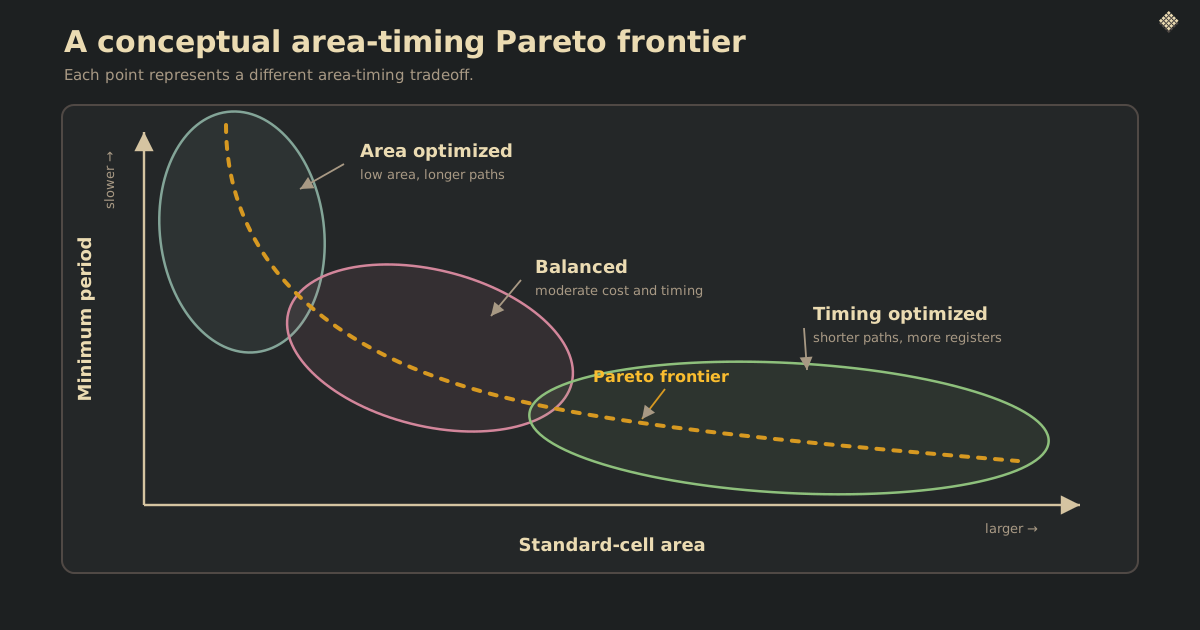
Finding the Pareto Optimal
Area and timing often pull a design in different directions, making this one of the most common hardware tradeoffs. Many designs need to implement long chains of combinational logic, which become difficult to close when the target clock frequency is high. Pipelining breaks those chains into shorter paths, but the additional registers trade area and latency for the ability to meet timing constraints.
What if we wanted to minimize the cell area of a design for a given clock target? Or, given a cell-area budget, determine the highest clock frequency at which the design could close timing? In either case, we would be looking for a Pareto-optimal implementation: a point for which no measured alternative is both smaller and faster.
This does not produce one winner by itself. It produces the set of candidates worth considering. An area budget can select the fastest point that fits, while a timing requirement can select the smallest point that closes timing. Changing the constraint can change the answer without changing any of the measurements.
The Pareto curve shown above was adapted from Michanan, Dewri, and Rutherford's Pareto analysis of live power and performance data. Their study found optimal cache configurations that were sparse in the design space and sometimes counterintuitive, reinforcing the value of comparing measured alternatives.
Choose hardware that makes the experiment approachable
We built the experiment in hardmatrix-examples around two intentionally simple blocks. The first applies 64 add, rotate, and XOR rounds to two words, a regular chain similar to the ARX operations used in cryptographic primitives such as ChaCha20. The second evaluates a 64-coefficient Reed-Solomon locator polynomial with Horner's method over GF(2^10). Reed-Solomon codes are common in storage and high-speed communication systems, including Ethernet PCS/RS-FEC paths.
These blocks were useful because they contain substantial combinational work without making correctness difficult to understand. Both are a good fit for the area-timing tradeoff described above because they expose pipeline depth as a direct architectural control.
By varying the number of pipeline stages, we can build a synthesis loop that evaluates how each pipeline depth changes area and timing.
Building an Open Source Implementation Loop
In this sweep, Hydra expands the experiment matrix, while FuseSoC gives each point the same source, parameters, target, and constraints. The target uses OpenROAD Flow Scripts, Yosys, and OpenSTA to produce mapped area and timing evidence. In the next post, we will cover the technical details of this loop.
Because the flow is scriptable and reproducible, we no longer have to guess which pipeline depth is best for the stated constraints. The real power of this approach is that we can use evidence from implementation tools to make architectural decisions.
What the Complete Sweep Reveals
We synthesized every integer pipeline depth from 1 through 64 for both blocks. We used a 1 GHz clock target and stopped at post-synthesis static timing analysis, without physical resynthesis. The resulting 128 points show why a small handpicked set can be misleading. Area does not increase smoothly, and minimum period does not improve by a fixed amount with every added stage. Synthesis and technology mapping reshape the logic at each point.
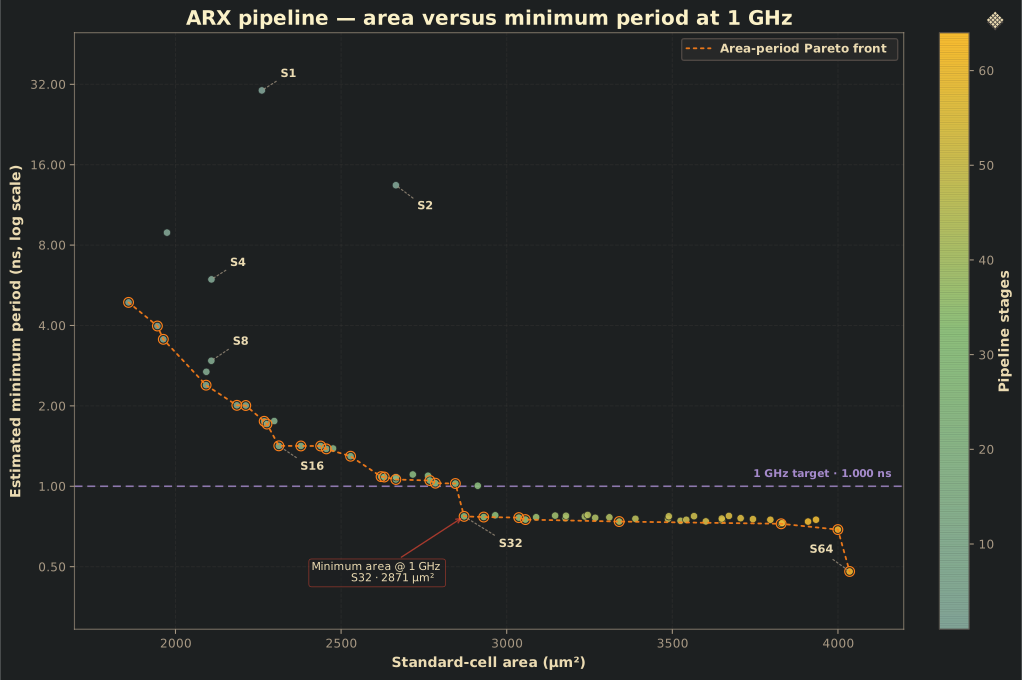
The measurements also separate questions that are easy to blur together. The 32-stage ARX point is the smallest implementation that meets 1 GHz. Under a 3,000 µm² area budget, however, the 34-stage point is faster and still fits. Neither point is universally better. Each answers a different constraint.
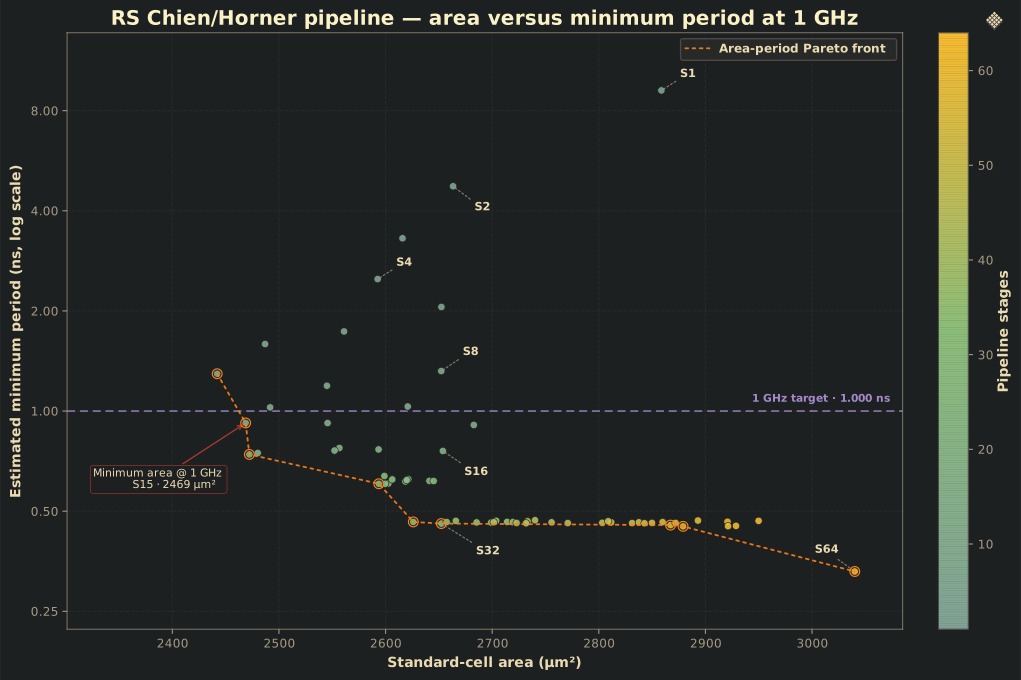
The Reed-Solomon result makes this visible in another way. Fifteen stages is the minimum-area implementation that meets the 1 GHz target, even though 16 stages looks like the more natural architectural choice. A designer might still choose 16 for another reason, but area and timing alone do not justify it in this experiment.
Using the Frontier to Guide Design Decisions
The results are post-synthesis estimates on the open ASAP7 predictive platform. They do not include placement, routing, extracted parasitics, clock tree cost, or signoff analysis. A different library, clock constraint, physical context, or optimization strategy can produce a different frontier.
That limitation is part of the method. We define the design space and evidence before using the word optimal. Within that boundary, the Pareto frontier tells us which implementations deserve further work. Later physical stages can repeat the comparison with better models and reduce the candidate set again.
The same approach can extend beyond pipeline depth to lane count, unrolling, queue depth, memory structure, operator sharing, or backend strategy. Open source tools make those iterations accessible enough to become part of normal architecture work. The same concept can also be used to identify architectural optimizations, for example by using Chisel to compare generator-level decisions instead of varying only RTL parameters.